
Generated editorial image.
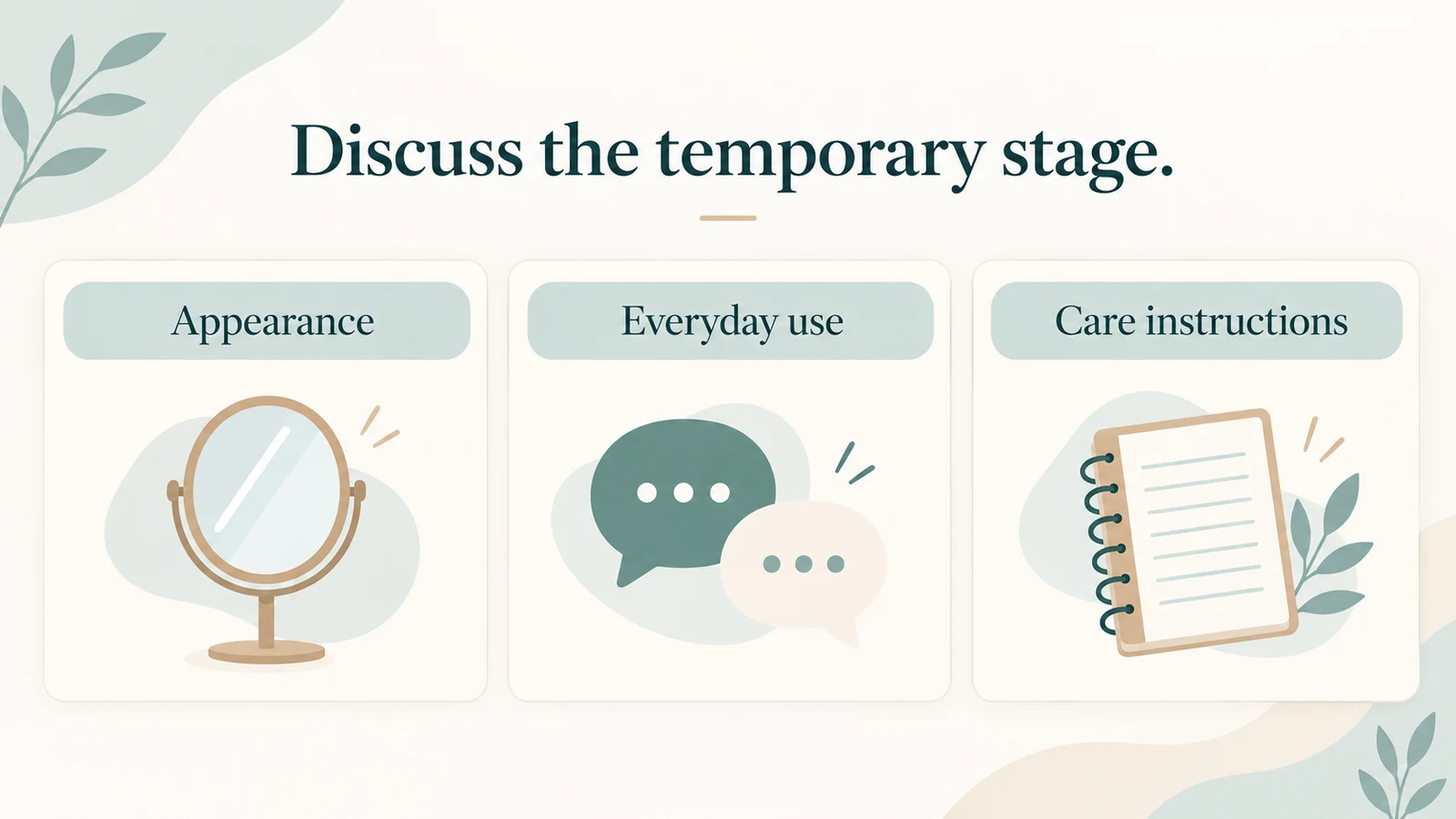
When a front tooth needs replacement, ask about the time before the final restoration as well as the finished result. Explain your concerns about appearance, speaking, meals and upcoming events early. The temporary-stage plan needs to fit the treatment and healing requirements.
A temporary option is not guaranteed in every situation. Ask what is appropriate for your mouth, when it could be used and what its limits would be before planning around it.
Explain what matters in everyday life
You may be thinking about a visible space during conversations, a work presentation or a family event. Tell the dental team what is coming up, including dates, rather than waiting until the treatment day.
Be specific about your priorities. “I speak with customers all day” gives the team useful context. So does “I will be away from home during the next stage.” Neither statement changes the clinical requirements, but both help identify questions that need an answer.
Ask whether there are periods when a proposed temporary cannot be worn or used for chewing. Appearance and function during an interim stage should be discussed separately so you do not assume that something filling a space can be used like a natural tooth.
Ask what an interim option would involve
Brock Cameron, DMD’s implant-crown service information says the office strives to provide an option to help mask a highly visible space. That is a reason to ask about your situation, not a promise of a particular device or immediate replacement.
Useful questions include:
- Is an interim option suitable at this stage?
- Would it be removable or fixed, and who manages it?
- What would it help with, and what would it not do?
- Could it need adjustment as treatment progresses?
- What costs are separate from the final restoration?
- What happens if the treatment schedule changes?
If the team discusses several possibilities, ask which are genuinely suitable for you. Product names or another person’s experience should not be treated as a menu of interchangeable choices.

Keep implant surgery and restoration roles clear
For Brock’s implant-crown care, the practice describes outside specialists placing the implant and Brock’s office creating and restoring the crown. Ask which team is responsible for any temporary option and who needs to approve its use.
The FDA explains that implant treatment and healing vary. Do not assume a final crown can be placed by a particular event or that an implant can immediately support a temporary tooth.
Before a handoff, confirm that the offices have the relevant plan and that you know which appointment comes next. Ask whom to contact about a loose temporary, a sore area, a surgical concern or a change in availability.
Get cleaning and use instructions for the actual option
If a temporary is provided, ask the treating team to demonstrate its care. Confirm whether it is meant to be removed at home, how to clean around it, what to do during meals, and any restrictions related to healing.
Do not apply a removable appliance’s instructions to a fixed restoration. Do not remove a fixed temporary yourself, adjust its shape, or use household glue if something comes loose. Contact the responsible clinician for advice.
Keep the instructions with the team’s contact details. If advice from two providers seems different, ask them to clarify it rather than choosing the easier version.
Plan for changes without promising a finish date
Ask what findings determine readiness for the final restoration and whether another review is needed first. Also ask what the temporary plan becomes if healing or laboratory work takes longer than anticipated.
Contact Brock Cameron, DMD to discuss a front-tooth replacement assessment, or explore its services. A clear interim plan can make the treatment sequence easier to understand while keeping clinical decisions with the treating teams.

We use modern dentistry to help address your dental needs by always staying current with treatment options that help provide each unique patient with the care that they need.
Contact Us
675 Old Ballas Rd. Suite 205
St. Louis MO 63141
Call Us
Copyright © 2025 Brock Cameron DMD.